A Game Design Div III by Luke Townsend
Hampshire College, 2020
Seek the Horizon
Breakdown, Set Up, How to Play
Overview
Seek the Horizon is a narrative, tile placement and exploration game played by 2-4 players. Acting as merchants, players will sail across unknown shores with goals to collect and sell goods, hire crew members, and complete quests to gain Explorer Points and become the best merchant on the seas.

Breakdown:
1. This is the name of your selected ship. All ships have the same starting stats, the only difference between them is minor; the name of your ship: The Condor, The Falcon, The Eagle, Vulture. The name of each ship has no gameplay effect.
2. This graphic shows the available actions a player can take at a town. See "How to Play: Town" below for further details.
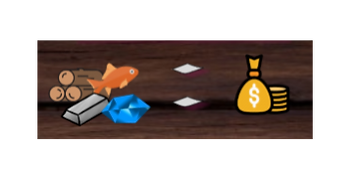
3. Resources are collected by the player throughout the game. When you sell them, the tracker moves down and eventually grants you bonus explorer points when you sell the required amount.
4. All ships have a starting movement of three. Movement is how many times a you can move during a turn.
5. Inventory is how many resources your ship can carry, which starts at two, and can be upgraded to three.
6. This tracker keeps tally of how many explorer points you've earned over the course of the game. Earning 14 points will win you the game.
7. These crew slots are where you place your crew members once you hire them. Without paying extra costs, you may have three active crew members under your hire. You may have more if you spend coins for each extra crew member you hire beyond the third. (e.g. if you were to hire a fourth crew member you'd have to pay their normal hiring cost, plus an additional coin. For a fifth, you'd pay two extra, and so on.).
Crew Member Breakdown
Crew members are cards that you can hire to give you bonus powers and effects that you wouldn't otherwise have access to. Additionally, crew members often have skills that are used to help complete quests for better rewards.
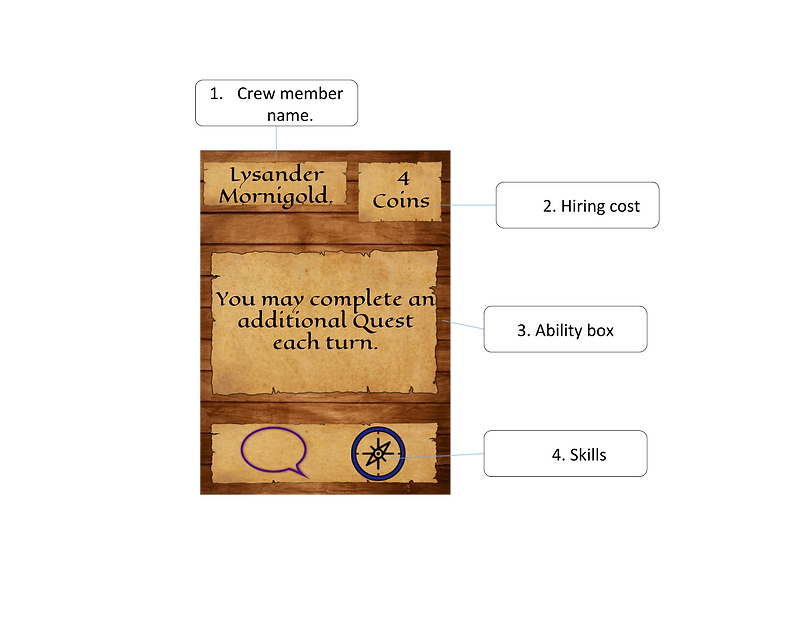
Breakdown:
1. Crew members all have unique names that have no gameplay effect.
2. The hiring cost is how many coins you need to pay so they work for you and are added to you crew.
3. Each crew member has a unique ability related to them. Crew member abilities only take effect if they've been apart of your crew from the start of your turn.
4. Many crew members have skills that help you complete quests. The more diversity of skills your crew members have, the more likely you are to earn better rewards.
5. There are a total of eight skills, non-legendary crew members typically have 0-3 skills.

Legendary Crew Member Breakdown
Legendary crew members are only available to hire by completing certain quests. They have a specific story tied to them, and can grant you even more power effects than normal crew members.
Breakdown:
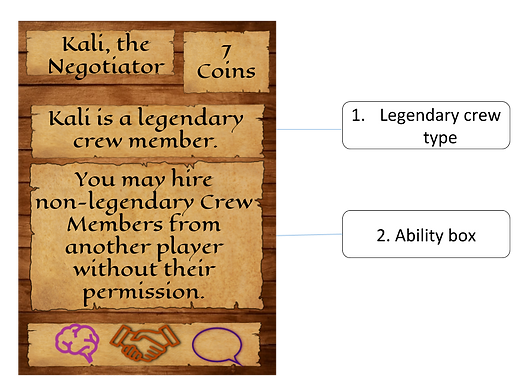
1. Some crew members have the legendary type line and are "legendary crew members".
2. Legendary crew members have powerful ability boxes, making them valuable additions to your crew.
Setup
1. Each player puts a marker on the "explorer point tracker" and one on each of the "resources sold tracker". Additionally, put a lock token on the third most inventory slot. Each player receives a "skill reminder card". The starting player receives two coins, each other player receives three.
2. Place the starting island tile in the center of table, accessible to all players. Each player places their ship pawn on the starting island tile.
3. Shuffle the 12 starting island tiles (labeled with "S") and stack them face down in an area accessible to all players. Shuffle the remaining tiles together and stack them face down but set them aside, as they will be used later in the game.
4. Place the reputation track and market board accessible to all players. Place a colored chip related to each player on the player reputation board, starting at zero. Place ten cubes on each of the resource tracks on the market board, corresponding to correct resources.
5. Set aside all legendary crew member cards and quest tokens. Shuffle the crew member deck and reveal the top three cards and place them next to the deck.
A typical set up will look like this, further spaced out:

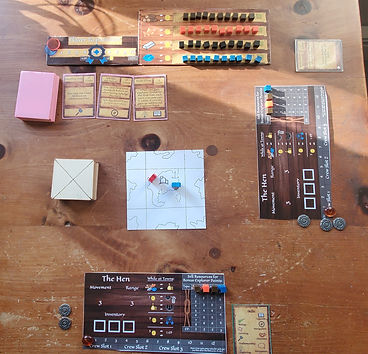
(the white starting tile is a prototype before the real one was finished)
How to Play
Below is a brief how to play, set-up, and strategy demo of Seek the Horizon. Additionally, below that are the rules written out in text form with examples for easy convenience.
At the start of your turn, you're given the choice to use the town at the beginning of your turn or at the end of your turn, not during the middle. If you don't start your turn at a town, the choice is made, continue on with your turn, you may use the town at the end of your turn instead. If you choose to use the town at the start of your turn, see "How to Play: Town" below for further details
Movement
The black lines that don't form islands are trade routes, these are the paths your ship pawns can travel on, and dictate which direction you can travel. Movement is broken into phases.
-
First, you may move from the anchor symbol you're currently on- called a port - to another port, no matter the distance of the tiles as long as they are accessible while passing on trade routes. This counts as one of your three possible movements.
-
You may move from port to port as many times as you have movement to "spend".
-
-
If you wish to move in a direction that does not have an island tile, reveal the topmost island tile of the tile stack, orient it how you see fit, and place it adjacent to the tile you are currently on. All tiles will be placeable next to any other tile - you may just not like how they fit. Revealing a new tile counts as using one of your three movement.
-
You may reveal as many tiles per turn as you have movement to "spend". You may not place tiles diagonally adjacent to you.
-
Resource placement
Once a new tile is place onto the board, it may have spots that need resources placed on them before you may continue your turn. Resource placement happens immediately after a tile is connected to existing tiles.
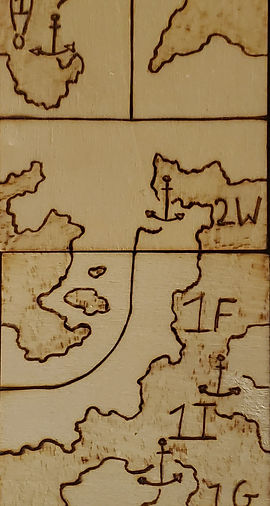
There are two types of resources that could be place onto a tile; trade goods (wood, fish, iron, gems) and quest tokens. Each are denoted with a corresponding letter/symbol and a number to denote how many of that type need placement.
There are 5 different resource symbols that could need resources place on those symbols:
-
W - Wood
-
I - Iron
-
F - Fish
-
G - Gems
-
! - Quest token
Each of these would have a number denoting how many are needed, and are placed directly onto of the symbol.
If there are no more trade good cubes of the required type or quest tokens to place onto a new tile, that spot will stay empty.
Once all the required resource have been placed, your turn may continue.
Quests
Quests are a fun way to gain rewards during the game. Completing quest could reward you with coins, explorer points, reputation, or legendary crew members. However, some quests have negative effects if your reputation isn't high enough.
Anytime you are docked at a port (your ship pawn is at port [anchor symbol]), and there is a quest token there, you may choose to complete that quest. Remove the quest token, read the number and letter assigned to that quest (e.g. 1A), and have the player to the right of you find the given quest in the questbook, and follow the steps bellow: .
-
The narrating player (i.e. the non-active player) will read the name of the location the quest is set in, title of the quest, the paragraph to provide narrative context, and two choices in bold for the active player to choose from. The narrating player may also remind the active player of the recommended skills to help complete the quest, also noted on the quest token.
-
Next, the active player chooses the option they like best to complete the quest, and the narrating player reads the next section to complete the story.
-
While some quest may reward you with negative effects if you have a low reputation, all quests are completable no matter your reputation level or number of hired crew members.
Quest tokens
Face down Face up


Town
The first OR last thing do on your turn is use town abilities, as mentioned previously. You may only use town abilities if you did not use the town at the start of your turn and only if you start or end your turn docked at a town.
Town Abilities:
-
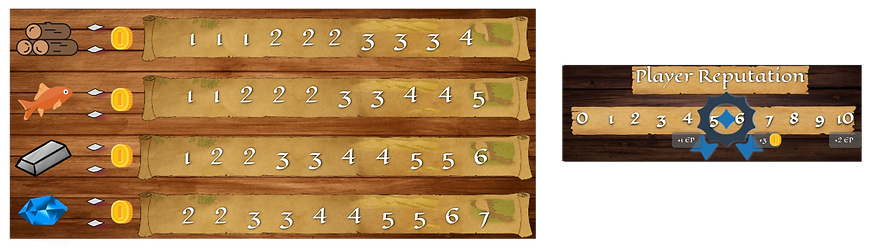
Sell Trade Goods: To sell good you've collected, place the colored cube (representing one of four trade goods) back onto the market board on the right most revealed number, and collect gold equal to that number. The more of that resource is on the board, the more valuable they become.
-
Hire Crew Members: In the upper right-hand corner of every crew member's card is their hiring cost. Spend the appropriate amount of gold to add them to your crew. If you hire any number of crew members from the pool, new ones don't get revealed until the end of your turn.
-
Additionally, you may spend one coin to "wipe' the pool of hirable crew members, send those to the discard pile, and reveal three new ones.
-
Note: You may replace active crew members with ones that you just hired. You may not get rid of a crew member from you have hired unless you are replacing it.
-
-
Buy Reputation: Spend three coins to gain one reputation. This ability can only be used once per turn.
-
Buy an Explorer Point: Spend five gold to gain one explorer point. This ability can only be used once per turn.


Reputation Tracker
Simply put, this tracks your reputation as it raises or lowers through the game. Reputation is what is used to determine what tier of reward you get. The higher your reputation, the more likely you are to receive good rewards. Some crew members are even dependant on you having a certain amount of reputation for them to stay in your crew.
All players start with a reputation of zero as stated in "Set Up". Once a player reaches 4 reputation for the first time in a game, they gain one explorer point. When a player reaches 7, you gain three coins. Once a player reaches ten, the maximum reputation, they receive another two explorer points.
Again, these bonuses are only available the first time that player reaches the required reputation.