A Game Design Div III by Luke Townsend
Hampshire College, 2020
Seek the Horizon
Crew Members
The link below will show all legendary and non-legendary crew members in a gallery for quick viewing. Further below, I breakdown each crew member in high level detail and discussion, talking about my design intentions, changes the card saw, and strong strategies that one could employ while using the card.
Legendary Crew Members
Legendary crew members were designed with the intent of being "famous people" in the world of Seek the Horizon. With powerful ability boxes and a good collection of skills, legendary crew members make for powerful allies if you have the coins to hire them. When designing all the crew members - not just the legendary one - I thought of them more as characters in a story rather than faceless cards. I thought more about what kind of personalities I want, and then that helped me fill in their name, ability boxes, and skills.
Legendary crew members are given to the player who completes certain quests as part of the reward for that quest. Only the player who completed that quest may hire the legendary tied to the quest, thus the reason they are set aside, and not added to the crew member deck. Hiring legendary crew members works the same as if they were in the normal crew pool and all appropriate costs must be paid for they can be added to your crew.

Kali, the Negotiator was designed knowing I wanted a sauve, smooth talking crew member that could "persuade" other crew members to come work for you. Kali's skills resemble her sauve attitude.
Originally Kali could "steal" any crew member, even legendaries. However through playtesting it was found that getting your special card stolen felt quite bad.
Kali is mostly used in the late game to help assemble "engine pieces", crew members that work well when paired with other specific members. Kali is an excellent tool to slow down players, combats Hilgashi, Soul Keeper, which I talk about below.

Dembe, the Builder - a humble and hard working man, Dembe shows loyalty to those who show it to him.
On the surface, Dembe looks pretty innocuous and basic. However after playtesting it was revealed just how powerful his simple ability is. While Dembe is powerful as is, I could see his stats changing to 6 coins and granting you three extra inventory slots. This change would make him feel more legendary, which is the only complaint the design has received. Dembe was the inspiration for regular crew members giving you extra inventory slots.
The strongest strategy for Dembe is to focus on collecting trade goods and maximize the extra space he grants you.

About one-third of the quests in Seek the Horizon have some sort of paranormal or fantasy element to them, and the rest are written as if set in the "real world". Lucia, Mother Werewolf comes from one of the fantasy quests.
The only change Lucia had while playtesting was altering the hiring cost from eight to seven. It's also possible Lucia should cost six, making up for the fact that she doesn't actually have an ability box, but rather an oversized skill box.
Lucia directs players to prioritize quests over anything else. She immediately grants +3 reputation on all quests, and few quests giving +4 reputation. Additionally, Lucia can save you money by not needing to hire crew members to have a diverse skill pool. The only reason you'd hire crew members would be for their ability boxes.
It's more interesting for crew members to not all be human, bringing diversity into the characters makes players more interested to try them out. I made sure to have an eclectic variety of options for players to choose from.
Valoosh saw some major changes before settling on this final design. Originally, Valoosh was a dual type card; legendary ship and legendary crew member. The idea was you hire Valoosh and they become more like a "steed" or "mount" the would replace your ship and be treated as a legendary crew member. See"Previous Iterations" for more information. This final design is one my favorite cards as Valoosh was a character I made early on in design and they survived all the way through to this final product.
Valoosh doesn't steer players in any specific direction. Rather, Valoosh allows you to continue whatever strategy you were focussing on and amplifies it by increasing your movement to complete tasks faster. Additionally, this crew member allows you to stay "open" if you don't have an active strategy. This card is favored by new and experienced players for its versatility and neutral strategy.


Hilgashi, Soul Keeper, like Lucia, is crew member based around the paranormal rather that real world truth. "The Ghost Ship" is a common sailors story that I knew I needed to recreate, which you can read in the questbook. Hilgashi is a spectre crew member, and arguably one of the most powerful.
A decrease in hiring costs from seven to six was the only change this card saw during design. Besides the skills Hilgashi has, it provides no immediate benefit when hired. However, left unchecked, Hilgashi grants near insurmountable card advantage by increasing the card pool from three to as many as there are discarded.
The key to Hilgashi being effective is to know when the correct time to hire it is. If you hire too early, you waste six coins and potentially slow your game down. Hire it too late and you may not have enough time to take advantage of the extra card pool given to you. The card also forces other players to think twice about clearing the card pool and reveal three new ones, as it just gives you greater access to different crea members. Uniquely, Hilgashi can do as much work waiting to be hired as it can once it is hired.
Crew Members
Non-legendary crew members make up the majority of your crew. These crew members were designed with the philosophy of creating characters, just like the legendary crew members. However, they were also designed to fill different "engine roles" and enable strategies that were otherwise lacking.
Every card won't be discussed individually, some will be grouped up when discussion of them would be similar.

Tobias was one of the last cards designed in the whole game. I wanted a strategy that encouraged you not to hire crew members, allowing players to focus on other aspects of the game.
Tobias's only change was removing the cunning skill due to playtest feedback. Tobias, thanks to his ability, is actually better without any skills than with a skill, and thus was changed to reflect his strategy.
Tobias really only has one strategy, and that's to hire him in the very early game and ride his ability to victory, completing as many quests as you can. Tobias can be a polarizing card, but he really does have to be hired early to be at maximum power level.
As mentioned in the legendary crew member section above, Dembe inspired a couple crew member cards to have inventory slots that you could use once hired. Players noted that they wanted this effect outside of a legendary crea member, and thus Sila and Rolland were created.
Notice that Sila costs three coins hire and Rolland costs two, this

isn't an accident. The cunning skill is more prominent in quests than craftsmanship is, thus accounting for the higher price as it's more valuable to more players.

These two complete a unique, albeit niche pair of cards. Thelma and Lillian are two cards that both create tokens, one town and one quest token. The quest tokens is explained in "How to Play: Quests". The town token creates a town on the given island, making it so you don't have to use movement to use town abilities. These cards are niche but have their uses.
This next groups is another series of niche but useful cards. In design, not all cards can be as good as every other card, you want a correct balance of power. While that normally that philosophy in TCGs/CCGs, I chose to utilize it for Seek the Horizon as well. There is an element of "set collection" that players try to do as it will always be better to have one crew member with the cunning skill and one with the persuasion skill, than both of them having the cunning skill.
Quinlyn and Dra'ak were designed as good early game crew to hire that aren't taxing on your coins, while potentially getting better late game if you're willing to satisfy their costs.
Here's a common play pattern that can happen to utilize these two effectively:
-
Use one movement to go pick up enough trade goods to fill your inventory (you could also start your turn with a full inventory if you're waiting for the price to increase on items".
-
Use another movement to travel to an island with a quest and complete it. With a full inventory, you now have at least two skills to help get better rewards from the quest.
-
Use your last movement to travel to a town and sell the trade goods you just collected.
This is an easily accomplished task early game that requires a one coin investment, which is perfectly reasonable.


These next four cards were called "crew pairs" in playtesting. These were designed with the notion that people could become stronger if they had the right person alongside them, whether it be family or friend.
Ella and Ava Corvus cost less to hire if you already have one of them; two for the price of one. However they are worse on their own, but no completely terrible; two coins for one skill isn't the worst deal if you really need that skill. Players also enjoy the flashy play of hiring one to complete the pair.
Baker and Johann are a bit more of a complex pairing. If you hired Johann, then Baker gets an additional skill; three skills for three coins is a good rate, especially when those skills are pretty common. If you hired Baker, Johann doesn't use a crew slot, essentially making a free slot for himself and still has two skills.
The crew pairs are a fun way to have useful crew members with interesting effects. These may not be top-tier crew members, but they can be successful in the right situations.
As I stated before with Valoosh and Hilgashi, players enjoy having non-human crew members. Spledge was designed to fill the classic "sailor with a parrot companion" trope.
I knew I didn't want players to have to hire Spledge. To me, it made more sense thematically that Spledge would follow its sailor friend along without having to be given coins. Additionally, Splegde would "sit on the shoulder of sailor" rather than use a crew slot. Lastly, since Spledge is a parrot, and parrots fly, Spledge has the navigation skill.
Spledge isn't a crew member you build around, and thus doesn't really have a strategy that goes along with it. It's a card you pick up for the skill when there are no other crew members you want to hire that turn.


As top-down design for a construction worker, Hayshep grants you the unique ability to use town abilities twice per turn.
Hayshep used to be templated differently; "You may use town abilities twice.". This created some confusion what it actually means in terms of effect. It was later simplified to this final template and has caused a lot less confusion.
As Hayshep only has one ability, it really forces you to get advantage out of the ability box. Picking up trade goods and hiring crew members is the best way to maximize the effectiveness of the ability box as with these, you're forced to use the town.
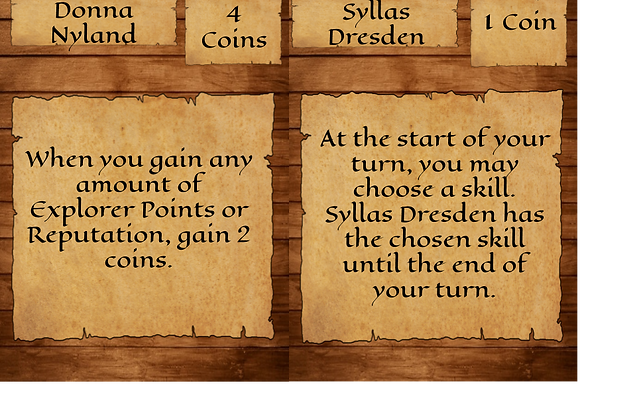
There are very few "skilless" crew members, three to be exact.
Syllas was designed to be a malleable crew member that could fill the skill you need for the turn. If you see a quest with a skill that you don't have, you can have Syllas gain that skill just for the turn to get a better reward from that quest.
Donna Nyland requires her own paragraph for a great discussion. Donna is the start to what are called "engine pieces", cards that work well when you have multiple cards that "chain" off of other abilities to create an engine.
Donna's ability can be a bit warping and create a snowball effect - once she gets going she won't stop. To combat this she wasn't given an ability. She's a top down design of a "sailing banker" - the investment is to gain explorer points or reputation, the return is money back.
The card plays like it reads, nothing too fancy or confusing about it. However, where things get interesting is when you pair it with other crew members that give you explorer points or reputation. Donna is one of the more coveted engine pieces in the game.
These two crew members were designed as ways of forcing players to interact with one another in positive ways. If you want these crew members for their skills, you need to work with someone in order to get them.
Often times what happens is players instead choose to clear the crew pool rather than give anyone else an advantage, however I still think they're valuable cards to have in the game.


One of the more interesting designs, Hadwick is only effective for you if you have a high reputation. This crew member essentially forces you to hire him later in the game after you've built up a reputation.
Hadwick allows players to replace the crew members they hired at the start of the game for various skills and low power effects, and replace one of them with Hadwick. Most crew members have on average 1.5 skills, Hadwich has four. While not having a helpful ability box, he more than makes up for it by having two-three crew members worth of skills.
These three crew members are classified as "utility". Additionally, they were designed bottom up, ability boxes first, then figured out matching skills. I felt that player could use these ability boxes in interesting ways.
Odion doesn't offer a specific strategy to work towards, offers a generic strong effects that is desirable to players.
Lysander does prompt players

to search for quests and complete them, but doesn't offer benefits to doing so other than the rewards one might receive from them.
Mia offers a strategy unlike any other. She doesn't provide you with any material gain, what she does offer is board control. The ability to lockdown ports you are docked at and prevent others from landing there makes it so you have control over your area. Other players will often be weary about revealing new tiles as it's likely they'll reveal something of interest to you.
As she's in the utility category, there isn't a specific strategy related to her other than paying close attention to all tiles that get revealed.

Starting with Candine, the last handful of crew members are the "engine pieces" I've been talking about. This particular one grants extra coins when you earn them from quests.
Candice was slightly more powerful when there wasn't a limitation on how many quests you could complete a turn. As that was ultimately changed to one quest a turn, she more balanced and didn't need to be changed.
Candice has a clear strategy of asking you to complete quests, and even provides two common skills to help you with them.

Ryan Ezras, Kendell Crest, and Creed Gallin are three engine pieces that give players additional explorer points.
Starting with Ryan, this card had to be edited several times as it was just too good. Originally, it triggered every time you earned explorer points, and it didn't require you to pay.

It didn't take long to realize Ryan was the best card in the game. That version didn't last through one playtest, it was hotfixed mid-game and only provided you with explorer points the first time you earned them, yet still didn't require you to pay. Through playtesting I reached this final version that is still very good, but balanced.
Next up is Kendell, who never once changed in design. From her first trial she was fun to play with and well balanced. It's possible she could cost one more, as she has a valuable ability box and desirable skill, but that change has yet to be tested.
Creed was another crew member that didn't really need any changes during design. The card is well costs for the ability box and skill he provides.
A good strategy with Creed is to either pair him with other crew members that give you extra coins for doing things, like Candice Hawthorne, or to go hard on searching for trade goods. These are two ways of gaining coins

The last engine piece card is Amos Cloverdale. Amos allows you to gain extra reputation and was a top-down design for "human resources". As your crew grows, so does the reputation you earn as a merchant.
Amos cares about hiring crew members, and is paired well with other effects that benefit you for doing so. However, he also works well when trying to complete a lot of quests as your reputation will be high as a result of hiring crew each turn.
Reputation gain isn't the most important thing in the game, and thus giving it to players is mostly through quests. You always will receive a "reward" from quests - whether it is positive or negative is up to how high your reputation is, but you'll still always get something. Players are also able to raise their reputation in a town, so having it on multiple crew members didn't make sense, and thus the reason only one card like this really exists.